
Make your own cider at home!
What is cider?
Cider is made from juice from crushed and pressed apples that have been allowed to ferment.Traditionally, cider contains 100% apple juice, with no other flavoring or added sugar.
You can also make cider from pears, (it is called perry).
Cider is usually served carbonated.
There are different styles of cider, which can be grouped by origin:
- Dry and light, English cider
- Fruity, slightly oxidized notes of applesauce, French cider
- Tart and dry, Spanish cider
The focus of this guide is traditionally produced cider (and not flavored cider which is also cider, as defined by the Food and Beverage Authority).
Choosing apples
Apples have mostly been grown for their qualities as eating apples, rather than as cider apples. Many Nordic apples are delicious and benefit from a relatively mild climate and many hours of sunshine during the summer months, which results in apples with a high sugar content and some acidity. But when yeast consumes the sugar from the apple juice, not much is left but the acidity, which makes the cider a little thin, tart and less complex. Fortunately, there are opportunities to influence this yourself!You can make cider from any kind of apple, but the best cider apples are generally not very good to eat. Good cider apples have higher acidity and relatively high tannins, which contribute to a fuller cider. Cider apples are usually described as bittersweet or bittersour.
If you have your own apple trees, you probably choose to pick the apples from these trees. If you have the opportunity to mix in several different apple varieties, it can produce cider with a more complex taste. So if your neighbor has other kinds of apple trees, it might be a good idea to mix your apples. If you jointly invest in equipment, the initial cost of pressing apples and making cider will also be lower.
Even if you don't have access to optimal cider apple varieties, the apples can still make good cider. And if you have juiceed them, you might as well try making a little cider too!
Apple types for cider:
Sweet apples Low acidity and high sweetness, use the majority (50 - 60%) of this type of fruit
Bitter apples Usually used at 10 - 30%. It is possible to mix in varieties of wild apples, paradise apples, quinces and the like.
Sweet and sour apples (so-called dessert apples) Ferment out and give relatively high acidity but rarely a complex character
Suggested apple varieties: cox pomona, cox orange, gala, rubinola, wilhelmine, katja, belle de boskoop, housewife, etc.
Equipment
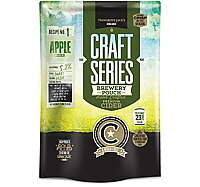
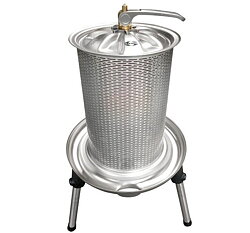
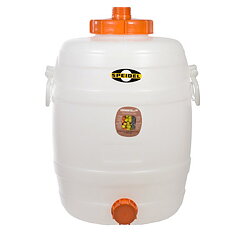
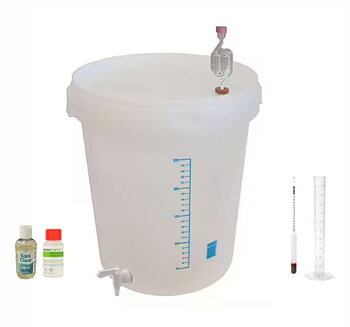
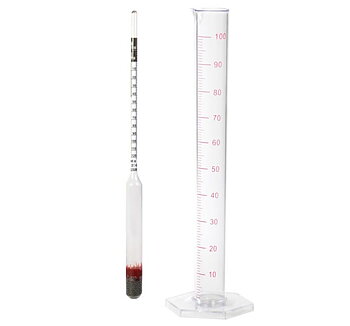
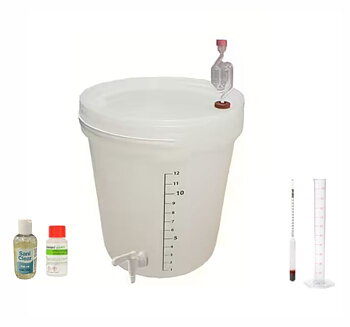
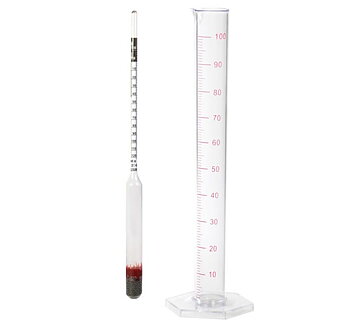
We have gathered most of the necessary equipment for cider production and there you will also find starter kits for you who want to easily start fermenting cider at home.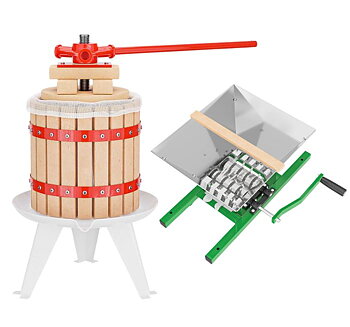
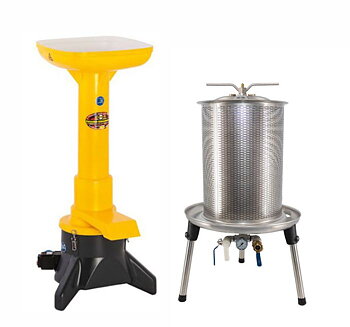
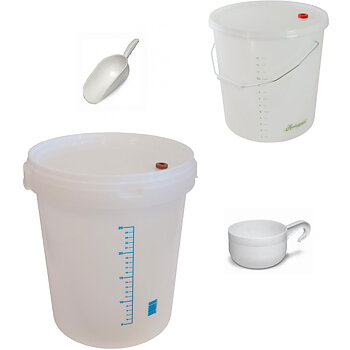
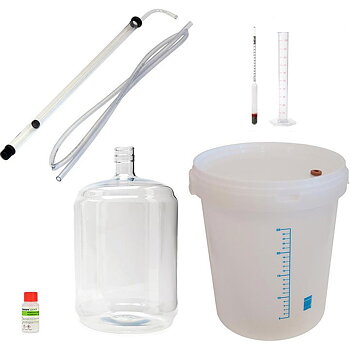
Pressing
- Start by immersing or rinsing the apples in water to remove any soil, leaves or dirt that may be on the skin.
Fresh apples float! If any apples have started to rot - throw them away.
Small brown marks or bruises are usually OK as long as the peel is intact. - After the apples are cleaned, they need to be finely divided.
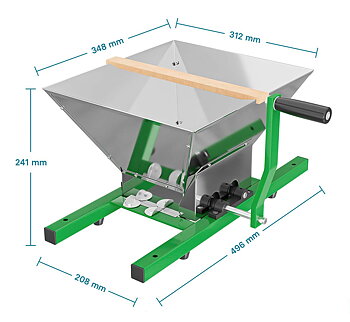
By crushing or finely chopping the apples into a pulp, it becomes easier to squeeze out the juice.
The goal is to squeeze as much as possible out of the pulp. What remains are fibres, pulp, peel and seeds. - You can choose to let the pulp rest for up to a day before pressing. This is called maceration. During the maceration, the pulp turns brown through oxidation, at the same time that the cells of the pulp begin to break down. This makes it a little easier to squeeze out juice. In addition, tannins and aromas are released during maceration. The juice often becomes slightly darker and clearer from this extra step in the manufacturing process.
- Apples contain approximately 80% water, and a good crushing and pressing results in 50 - 75% efficiency.
Each kg of apples should yield between 4 - 6 dl of juice. - Juice largely contains simple sugars that ferment out completely.
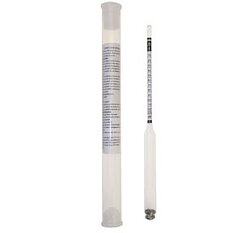
Raw applesauce contains about 10 - 15% sugar. It corresponds to an OG of 1.045 - 1.070 measured with a hydrometer.
Factors that affect the sugar content are the weather of the growing season and the apple variety.
The sugar content determines the alcohol content in the finished cider. An alcohol content of 6 - 8% alcohol is normal.

Juice
Apple juice is quite cloudy after pressing. It contains fruit residues, soluble fruit fiber and pectin.A sieve or coarse mesh filter can be used to remove the largest pieces of peel and fruit.
The juice quickly begins to oxidize and turn brown quickly from enzymes, which can be counteracted by:
- Add citric or ascorbic acid. Lower pH denatures the enzymes.
- Choose apple varieties with a high content of vitamin C (e.g. Rubinola).
- Reduce the juice's oxygen contact by covering it with inert gas or vaseline oil.
- Pasteurize the juice.
Apples naturally contain some enzymes that slowly break down pectin.
Therefore, it is wise to reduce turbidity and pectin content before fermentation.
The addition of clarifying agents makes it easier to get a clear juice. We recommend:
Pectolase, an enzyme that breaks down and reduces the content of pectin. Pectolas can be added directly after pressing the apples and then needs to work for at least a couple of hours.
Bentonite, a type of clay that has a long history of use for clarifying e.g. wines.
Dissolve in water a few hours before use. Can be whisked into the juice a couple of hours after Pectolase has been added.
By keeping the juice cool overnight, the particles can settle to the bottom or top of the vessel. Clear juice can then be separated from cloudy liquid.
Fermentation
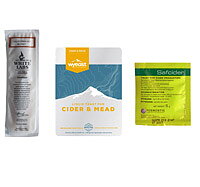
If you don't do anything with the juice, it will eventually start to ferment on its own, due to all the wild yeast and bacteria naturally present on the skins of the apples. This will take longer and the result will not always be good, as unwanted flavors and vinegary notes often arise. This type of cider is often categorized as spontaneously fermented cider, natural cider or the like.For a faster and more predictable result, it is recommended that you add yeast.
Traditionally, the British used English ale yeast for their ciders and the French added wine or champagne yeast to their ciders.
The choice of type of yeast contributed to some extent to the typical flavors of cider in the different regions.
Raw juice lasts a couple of days in refrigerated storage. If you want to save the juice or want to make sure that wild yeast or bacteria will not take hold and affect the taste of the cider, you need to pasteurize or add sulfur to the juice.
- Pasteurization means that the juice is heated, a standard is 80 °C for 20 minutes. The juice then needs to be cooled before you can add yeast.
- To sulphurise the juice you add potassium disulphite (E224) or sodium disulphite, also called Wine sulphur, or Campden powder/tablets. Typical dosage is 1 - 2 grams per 10 liters. Wait for about 24 hours so that most of the sulfur has had time to aerate out in gas form, then it is fine to add the yeast. If you have added sulfur before fermentation, it is often recommended to also add sulfur before storage and bottling.
After sulfurization or pasteurization, it is possible to save the juice as it is, without fermenting it into cider. In that case, bottle the juice in well-cleaned and disinfected bottles, bag-in-boxes or in other oxygen-tight containers.
Yeast nutrients are recommended when fermenting cider, as apples do not contain all the nutrients and minerals the yeast needs to do its job.
Follow the yeast manufacturer's instructions and be sure to keep all fermentation and bottling equipment clean and disinfected.
For a cleaner result, some cider makers choose to ferment their cider cold, below 10°C. The fermentation time will increase significantly, but it can also give a better end result. The slow fermentation process means that more of the juice's flavors and aromas are retained in the cider.
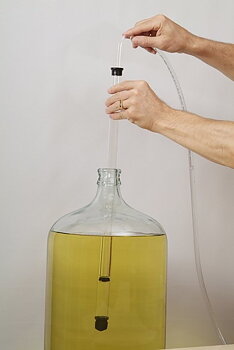
It is common for the cider to be decanted into a new fermentation vessel eventually, when the main fermentation is complete. It is done to get rid of the sediment and produces a brighter cider. It is good if the bottling is done carefully (e.g. with a siphon) without oxygenating the cider unnecessarily. It is ideal if the cider fills up the receiving vessel well, so that there is not much air left above the cider.
At a later stage of storage, it may be good to raise the temperature slightly, to allow certain sulfur compounds to be aired out. This is particularly important if you also intend to let the cider undergo a so-called malolactic fermentation, where lactic acid bacteria convert the sharp malic acid into milder lactic acid over several months. For this to happen the temperature must be above 17°C, the cider must be above pH 4 and sulphur/sulphite should not have been added earlier in the process.
A good advice when it comes to fermenting and storing cider is not to be in too much of a hurry. Commercial cider makers often expect a lead time of 12 - 18 months, from fruit to finished bottled cider. In many cases, cider can be at its peak after a couple of years, provided the production and bottling have been handled correctly.
Back sweetening
When the cider is fully fermented, almost all the sugar has been fermented. This can make the cider feel a little thin in the body. In order to give the cider some sweetness and thereby enhance the complexity of the cider, it is possible to back sweeten the cider. This is usually done before bottling.You can sweeten it using sugar, apple juice or sweetener. Depending on the taste and balance of the cider, it is difficult to give general guidelines for the amounts needed. Take a small sample of the cider and add sweetening in small amounts, until you reach the proportions that are best. Then scale up the amounts to the full batch of cider.
If you sweeten with sugar or apple juice, the yeast normally ferments all the sugar again. To prevent this, additives can be used, so that the yeast is passivated. The most common additives to prevent fermentation are a combination of potassium disulfite (E224) and potassium sorbate (E202).
It is also possible to filter or pasteurize cider to remove the yeast, but this requires special equipment.
Since the yeast is passivated by the additives, it will not be possible to carbonate the cider by bottle condidioning. It is also not suitable to add new yeast as it will ferment the added sugar.
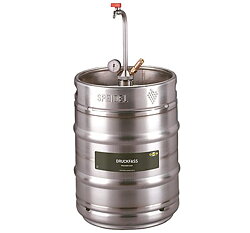
Instead, you could carbonate the cider in a pressure vessel through so-called forced carbonation. Common pressure barrels are, for example, cornelius kegs or party kegs.
If sweeteners are used, yeast usually cannot ferment this. This means that other additives do not need to be added and that it is possible to carbonate the cider using bottle conditioning. Examples of sweeteners that can be used are Sucralose or Stevia. Keep in mind that sweeteners have different degrees of sweetness and that they can have aftertastes that are perceived negatively.
Bottling
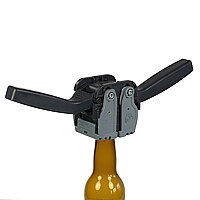
To get carbonation and bubbles in its cider, it needs to undergo a fermentation in the bottles. To achieve this, an additional small amount of sugar must be added, which the yeast can then convert into carbon dioxide inside the sealed bottle.A good starting point is 6 grams of sugar per liter of cider. Let the bottles sit at room temperature for 1 - 2 weeks, until they are carbonated. Then store the bottles cool.
Ice cider
Not everyone appreciates cider, the reasons may be that the drink is too sour, tart, or something else. The vast majority, however, usually appreciate enjoying a glass of ice cider, which can be described as a soft, higher alcohol and aromatically more intense cider.To make ice cider, it can be done according to two methods:
- Freeze the fruit or fruit pulp and then squeeze it while thawing. The result is differently concentrated depending on how thawed the fruit is. It is possible to get a juice that is up to 4 times as concentrated, compared to regular apple juice, with that method.
- Squeeze as usual and then freeze some of the water in the juice, so that the rest of the juice gets a higher concentration of sugar and flavorings. The process means that flavors and sugar content are concentrated, without acrid and astringent notes taking over. Expect to get about a quarter as much juice, compared to a normal juicing.
Best enjoyed as a wine.
Make apple cider vinegar
You can make apple cider vinegar from fermented, dry cider.Use cider with at least 5% alcohol that does not contain sulfur that can prevent the process that creates acetic acid. To give the vinegar a good start, you can add purchased vinegar (wine or cider vinegar) that does not contain sulfur or other preservatives.
Pour the cider into a vessel with access to air, covered with a cloth so that no fruit flies can enter. The future vinegar should be kept warm and dark, preferably above 20 °C. The bacteria that convert alcohol to acetic acid will create a lump that floats to the surface. The lump is called vinegar mother and is completely normal for the process.
The process of converting cider into vinegar normally takes a couple of months. When you are happy with the taste of the vinegar, you can drain off 2/3 of your apple cider vinegar and then top up with new cider if you want to make more vinegar.
A good advice:
Keep your vinegar making separate from your cider fermentation or beer brewing! Use different fermentation vessels and bottling equipment for vinegar than for other beverages, so that your beer, cider or juice does not start to sour from the bacteria from the vinegar making.