0
Your cart
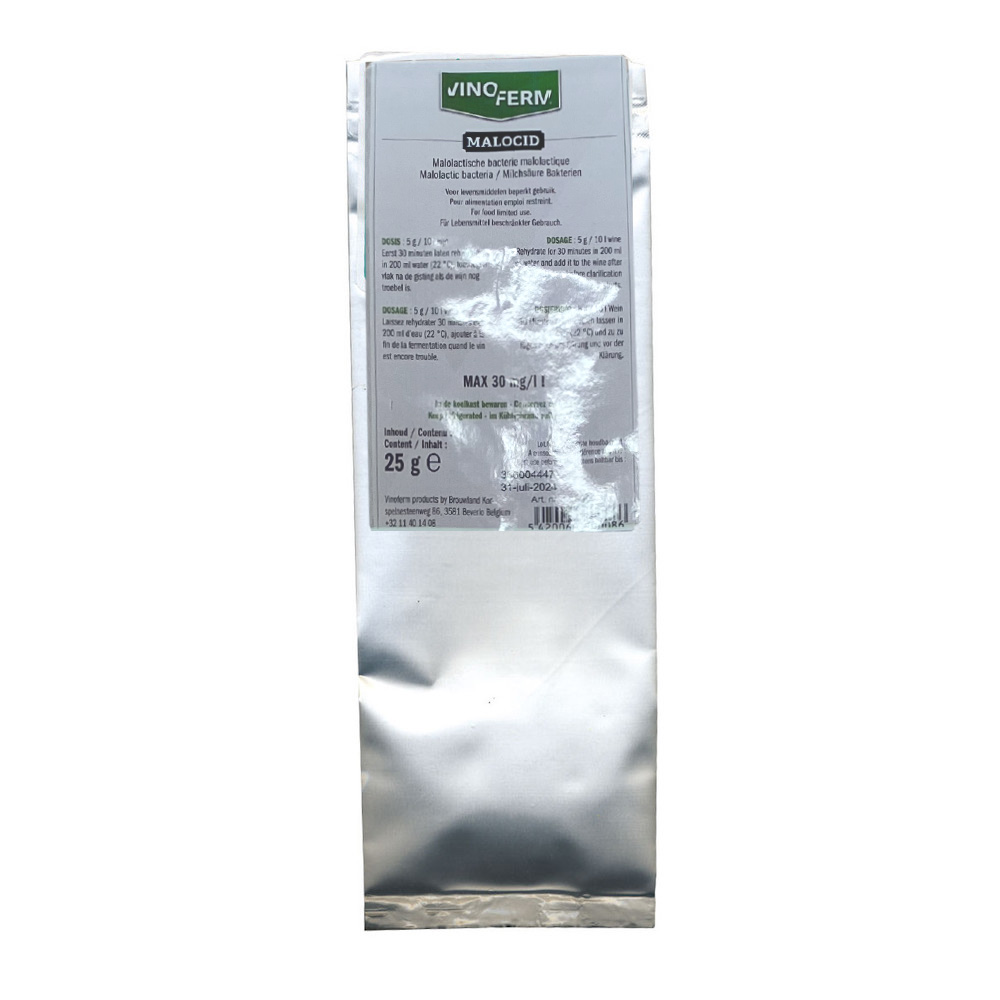
Malocid dry malolactic bacteria, 25 g

Malocid dry malolactic bacteria, 25 g

5.0
141.02 SEK
Add to list of favorites
Read more...

Description

Article no.: 191137

Culture for a controlled malolactic fermentation. It contains a high concentration of Leuconostoc Oenos bacteria, which converts the present malic acid into tartaric acid. This reduces the acidity and softens the flavour.

Dosage: 5 g/10 l wine.
Add to the wine after fermentation and before clarification.
Rehydrate bacteria culture in 10 times its weight in water 25 °C.

Lactic acid bacteria have completely different environmental requirements than yeasts. Malolactic fermentation is best started just before the end of the alcoholic fermentation (residual sugar < 4 g/l). The free SO2 content must be a maximum of 10 mg/litre and the total SO2 content a maximum of 30 mg/litre. The pH value of the wine must be at least 3.1 and the alcohol content must be a maximum of 13%vol. Finally, the temperature of the wine is also very important: 17°C or more.

Alcohol tolerance: 13 %
Optimum fermentation temperature: 17+ °C

In stock: 29

  • Fast delivery
  • International shipping
  • E-mail us, we reply swiftly!

    Description

    Article no.: 191137

    Culture for a controlled malolactic fermentation. It contains a high concentration of Leuconostoc Oenos bacteria, which converts the present malic acid into tartaric acid. This reduces the acidity and softens the flavour.

    Dosage: 5 g/10 l wine.
    Add to the wine after fermentation and before clarification.
    Rehydrate bacteria culture in 10 times its weight in water 25 °C.

    Lactic acid bacteria have completely different environmental requirements than yeasts. Malolactic fermentation is best started just before the end of the alcoholic fermentation (residual sugar < 4 g/l). The free SO2 content must be a maximum of 10 mg/litre and the total SO2 content a maximum of 30 mg/litre. The pH value of the wine must be at least 3.1 and the alcohol content must be a maximum of 13%vol. Finally, the temperature of the wine is also very important: 17°C or more.

    Alcohol tolerance: 13 %
    Optimum fermentation temperature: 17+ °C

    Recensioner

    5.0
    Baserat på 1 betyg1 betyg
    5
    4
    3
    2
    1
    Recensioner (1)
    Recensioner (1)
    Powered by TestFreaks
    Gösta B

    Fungerar perfekt!

    Frågor och svar

    Ställ en fråga
    Frågor och svar (1)
    Ställ en fråga
    Frågor och svar (1)
    Powered by TestFreaks
    Erik
    Finns bra sätt att mäta eller på annat avgöra om förutsättningarna för den malolaktiska processen går bra? Vad händer med vinet om processen inte fungerar som det ska?

    Det handlar om röda krossade druvor som jäser med skal och kärnor kvar i satsen.

    Kundtjänst

    Det finns inte så många enkla sätt att avgöra exakt hur den malolaktiska fermenteringen (MLF) går. Ofta kan en viss efterjäsning uppstå som märks främst från att kolsyra avgår som gasbubblor.

    En metod för att avgöra om det mesta av äppelsyran omvandlats till mjölksyra är att använda papperskromatografi, men detta är tyvärr inget som vi har i vårt sortiment. Den här artikeln (extern länk) tycker jag ändå beskriver bra hur kromatografin går till: https://winemakermag.com/technique/testing-for-malolactic-dont-be-in-doubt

    Om MLF-processen inte fungerar som det ska så omvandlas inte den skarpa äppelsyran till den mjukare mjölksyran. Några faktorer som kan påverka MLF negativt: för låg temperatur, för lågt pH, för hög alkoholhalt.

    -- Klas