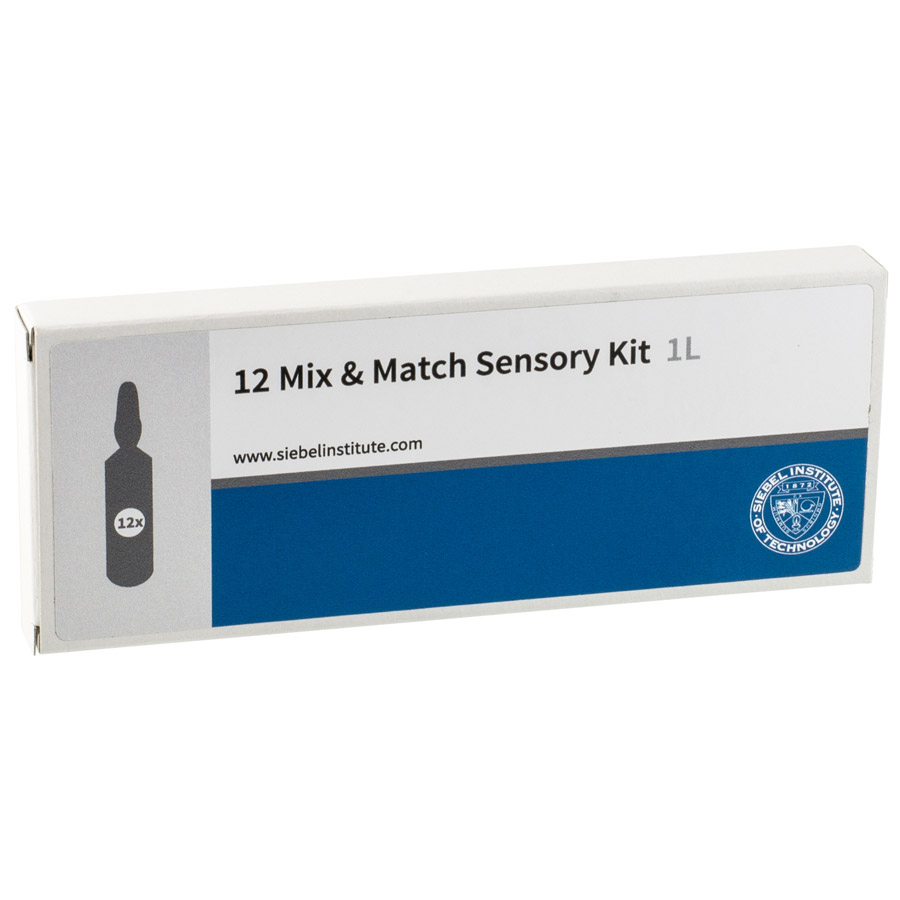
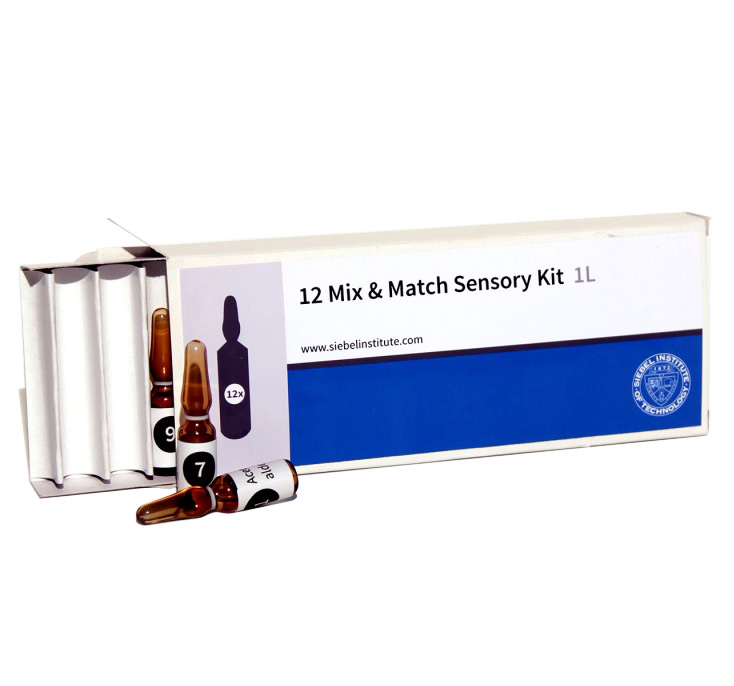
Teach yourself the most common off-flavours in beer with this Sensory kit from the Siebel Institute.
By comparing a flavoured beer with a control sample, you can develop your knowledge about how flavour and aroma is connected to different factors in brewing, racking and storing beer. This gives a broader understanding for sampling, brewing and judging beer, and is useful for "tester calibration".
The Sensory kit is suitable for a group of testers, for example as a tasting event, in brew clubs, with beer judges or in other educational circumstances.
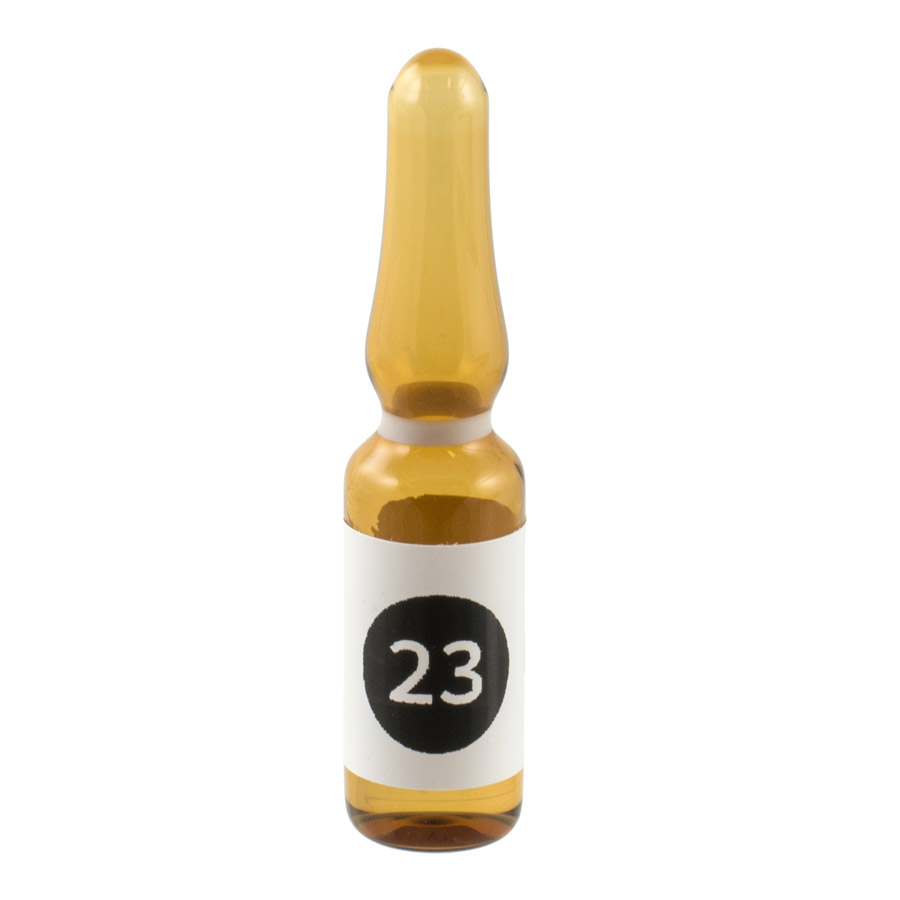
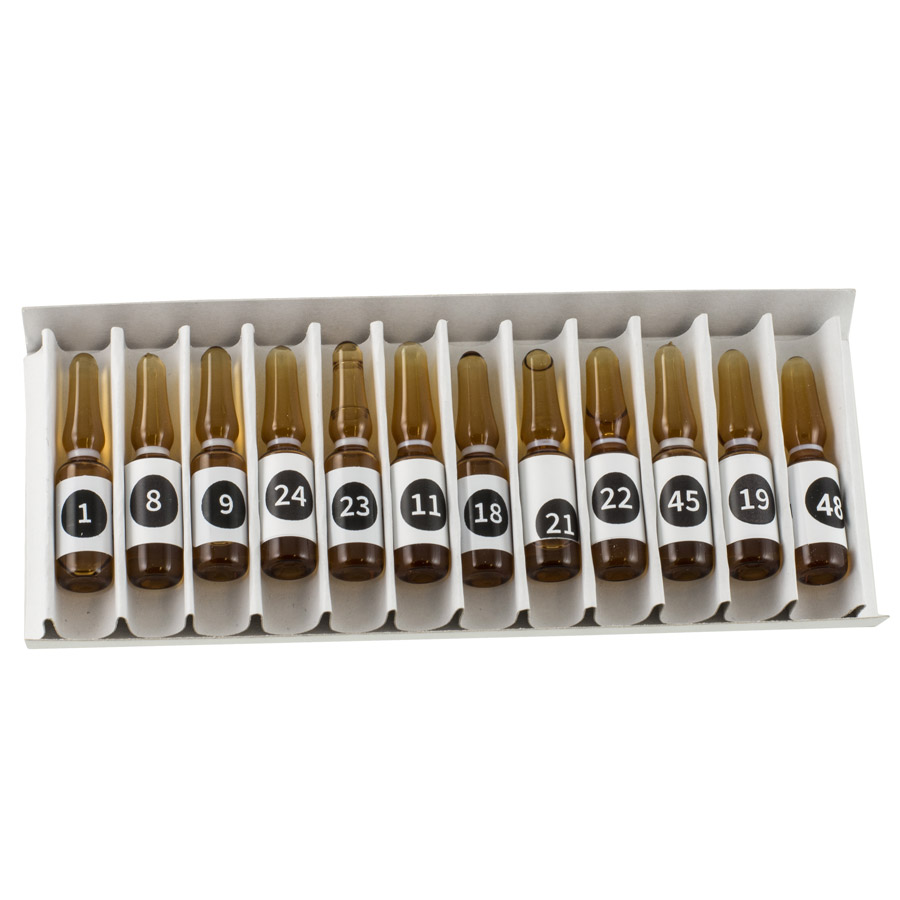
Contains a set of 12 single use glass vials, with the flavours:
• Acetaldehyd (Green apple) Common sources: stalled fermentation or contact with oxygen Concentration: 45 mg/l. Threshold in beer: 10-20 mg/l.
• DMS / Dimethyl sulfide (Cooked corn, cooked vegetables) Common sources: too short wort boil or slow wort cooling Concentration: 200 μg/l. Threshold in beer: 25-50 μg/l.
• Diacetyl / 2,3-Butanedione (Butter, butterscotch) Common sources: stalled fermentation or improper maturation, microbial contamination Concentration: 0.6 mg/l. Threshold in beer: 0.1-0.2 mg/l.
• Spicy / Eugenol (Cloves, all spice) Common sources: bi-product of fermentation, microbial contamination or aging Concentration: 120 μg/l. Threshold in beer: 40 μg/l.
• Paper / Trans-2-nonenal (Cardboard, oxidized) Common sources: contact with oxygen during brewing, racking or storage Concentration: 2 μg/l. Threshold in beer: 0.5 μg/l.
• Ethyl acetate (solvent-like, nail polish remover) Common sources: fermentation temperature, underpitching or wild yeast Concentration 60 mg/l. Threshold in beer 20-40 mg/l.
• Isovaleric acid (cheesy, sweaty socks, old hops) Common sources: use of old, degraded hops Concentration 3 mg/l. Threshold in beer 1 mg/l.
• Mercaptan (sewer-like, drains) Common sources: poor yeast health, autolysis Concentration 3.75 μg/l. Threshold in beer 1 μg/l.
• Metal (metallic, tin-like, blood) Common sources: water sources, non-passivated vessels Concentration 3.75 mg/l. Threshold in beer 1 mg/l.
• H2S (rotten eggs) Common sources: fermentation, maturation or contamination Concentration 72 µg/l. Threshold in beer: 4 µg/l
• Lactic acid (sour, sour milk) Common sources: beer spoilage bacteria Concentration: 400 mg/l. Threshold in beer 140 mg/l.
• Brett / Barnyard (barnyard, horsey, wine-like) Common sources: secondary fermentation with Brettanomyces / wild yeast Concentration: 10.0 µg/l. Threshold in beer: 0.30 µg/l.
Each vial is intended for 1 L of neutral beer, sufficient for at least 10 persons. Use the same beer as control sample.
Sample preparation (gives approx. 3x threshold level): • Use 1 L of beer per vial. • Carefully pour half the beer volume into a suitable pitcher. • Lightly snap the vial open at the top section. • Add the contents of the vial to the pitcher. • Gently pour the rest of the beer into the pitcher. • Serve samples of 80 - 100 ml, together with a control sample. • Smell, taste and swallow the sample. Take notice of differences from the control sample, preferably as a silent testing. • Discuss the differences between the two samples.
Teach yourself the most common off-flavours in beer with this Sensory kit from the Siebel Institute.
By comparing a flavoured beer with a control sample, you can develop your knowledge about how flavour and aroma is connected to different factors in brewing, racking and storing beer. This gives a broader understanding for sampling, brewing and judging beer, and is useful for "tester calibration".
The Sensory kit is suitable for a group of testers, for example as a tasting event, in brew clubs, with beer judges or in other educational circumstances.
Contains a set of 12 single use glass vials, with the flavours:
• Acetaldehyd (Green apple) Common sources: stalled fermentation or contact with oxygen Concentration: 45 mg/l. Threshold in beer: 10-20 mg/l.
• DMS / Dimethyl sulfide (Cooked corn, cooked vegetables) Common sources: too short wort boil or slow wort cooling Concentration: 200 μg/l. Threshold in beer: 25-50 μg/l.
• Diacetyl / 2,3-Butanedione (Butter, butterscotch) Common sources: stalled fermentation or improper maturation, microbial contamination Concentration: 0.6 mg/l. Threshold in beer: 0.1-0.2 mg/l.
• Spicy / Eugenol (Cloves, all spice) Common sources: bi-product of fermentation, microbial contamination or aging Concentration: 120 μg/l. Threshold in beer: 40 μg/l.
• Paper / Trans-2-nonenal (Cardboard, oxidized) Common sources: contact with oxygen during brewing, racking or storage Concentration: 2 μg/l. Threshold in beer: 0.5 μg/l.
• Ethyl acetate (solvent-like, nail polish remover) Common sources: fermentation temperature, underpitching or wild yeast Concentration 60 mg/l. Threshold in beer 20-40 mg/l.
• Isovaleric acid (cheesy, sweaty socks, old hops) Common sources: use of old, degraded hops Concentration 3 mg/l. Threshold in beer 1 mg/l.
• Mercaptan (sewer-like, drains) Common sources: poor yeast health, autolysis Concentration 3.75 μg/l. Threshold in beer 1 μg/l.
• Metal (metallic, tin-like, blood) Common sources: water sources, non-passivated vessels Concentration 3.75 mg/l. Threshold in beer 1 mg/l.
• H2S (rotten eggs) Common sources: fermentation, maturation or contamination Concentration 72 µg/l. Threshold in beer: 4 µg/l
• Lactic acid (sour, sour milk) Common sources: beer spoilage bacteria Concentration: 400 mg/l. Threshold in beer 140 mg/l.
• Brett / Barnyard (barnyard, horsey, wine-like) Common sources: secondary fermentation with Brettanomyces / wild yeast Concentration: 10.0 µg/l. Threshold in beer: 0.30 µg/l.
Each vial is intended for 1 L of neutral beer, sufficient for at least 10 persons. Use the same beer as control sample.
Sample preparation (gives approx. 3x threshold level): • Use 1 L of beer per vial. • Carefully pour half the beer volume into a suitable pitcher. • Lightly snap the vial open at the top section. • Add the contents of the vial to the pitcher. • Gently pour the rest of the beer into the pitcher. • Serve samples of 80 - 100 ml, together with a control sample. • Smell, taste and swallow the sample. Take notice of differences from the control sample, preferably as a silent testing. • Discuss the differences between the two samples.