0
Your cart
kit for closed transfer between pail and keg

kit for closed transfer between pail and keg

5.0
495 SEK
Add to list of favorites
Read more...

Description

Article no.: 895274

Package with couplings and tubing for oxygen-free transfer from fermenting pail to cornelius keg.

This kit assumes that you have a ball-lock cornelius keg and a fermentation vessel with a 9/12 mm spigot.

The package includes
1x Ball lock disconnect - 9,5 mm barb - liquid
1x Threaded ball lock disconnect - gas
1x John Guest 3/8" - 1/4" FFL
1x John Guest Elbow 3/8" stem
1m Silicone Hose (8 x 12 mm)
2 m Tubingflex 3/8" tubing

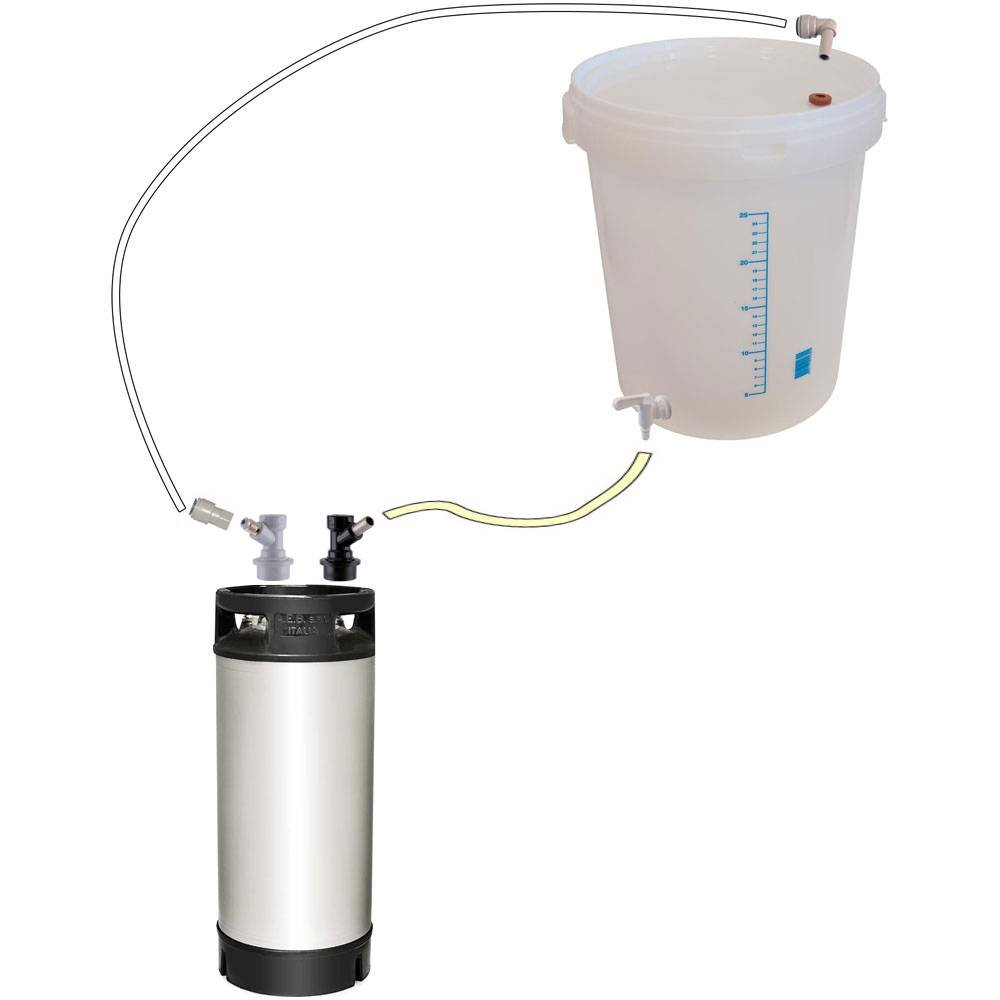
Easily assembled as shown in the picture.

Cornelius keg, pail and spigot 9/12 mm not included.

Assembly
Connect the fermenter spigot with the black ball-lock disconnect to the Liquid/OUT post on the keg (you want to fill the keg from the bottom - through the liquid diptube):
Silicone hose (8 x 12 mm)
Ball lock disconnect - 9,5 mm barb - liquid

The Gas/IN post on the keg is connected to the airlock hole on the fermenting pail:
Threaded ball lock disconnect - gas
John Guest 3/8" - 1/4" FFL
Transparent tubing 3/8"
John Guest Elbow 3/8" stem

Usage:
1. Make sure the keg is properly cleaned and filled with CO2
Fill the barrel with carbon dioxide and release the air in the top of the keg by pulling the safety relief valve several times. Or better yet, fill the barrel all the way up with e.g. Star San and push out with CO2. Release the overpressure by pulling the safety valve. Place the fermenter high, e.g. on a table and the keg on the floor.

2. Connect keg and fermenter as shown above. The spigot of the fermenter to the Liquid/OUT post and the Gas/IN post to the airlock hole on the fermenter.

3. Open the spigot. CO2 in the keg and beer in the fermenter will change places, without being exposed to oxygen.

  • Fast delivery
  • International shipping
  • E-mail us, we reply swiftly!

    Description

    Article no.: 895274

    Package with couplings and tubing for oxygen-free transfer from fermenting pail to cornelius keg.

    This kit assumes that you have a ball-lock cornelius keg and a fermentation vessel with a 9/12 mm spigot.

    The package includes
    1x Ball lock disconnect - 9,5 mm barb - liquid
    1x Threaded ball lock disconnect - gas
    1x John Guest 3/8" - 1/4" FFL
    1x John Guest Elbow 3/8" stem
    1m Silicone Hose (8 x 12 mm)
    2 m Tubingflex 3/8" tubing

    Easily assembled as shown in the picture.

    Cornelius keg, pail and spigot 9/12 mm not included.

    Assembly
    Connect the fermenter spigot with the black ball-lock disconnect to the Liquid/OUT post on the keg (you want to fill the keg from the bottom - through the liquid diptube):
    Silicone hose (8 x 12 mm)
    Ball lock disconnect - 9,5 mm barb - liquid

    The Gas/IN post on the keg is connected to the airlock hole on the fermenting pail:
    Threaded ball lock disconnect - gas
    John Guest 3/8" - 1/4" FFL
    Transparent tubing 3/8"
    John Guest Elbow 3/8" stem

    Usage:
    1. Make sure the keg is properly cleaned and filled with CO2
    Fill the barrel with carbon dioxide and release the air in the top of the keg by pulling the safety relief valve several times. Or better yet, fill the barrel all the way up with e.g. Star San and push out with CO2. Release the overpressure by pulling the safety valve. Place the fermenter high, e.g. on a table and the keg on the floor.

    2. Connect keg and fermenter as shown above. The spigot of the fermenter to the Liquid/OUT post and the Gas/IN post to the airlock hole on the fermenter.

    3. Open the spigot. CO2 in the keg and beer in the fermenter will change places, without being exposed to oxygen.

    Recensioner

    5.0
    Baserat på 5 betyg5 betyg
    5
    4
    3
    2
    1
    Recensioner (5)
    Recensioner (5)
    Powered by TestFreaks
    Joakim

    Lätt att sätta ihop och gav väldigt bra resultat jämfört när jag fört över utan detta tidigare

    Jonathan W
    Reine L

    Frågor och svar

    Ställ en fråga
    Frågor och svar (3)
    Ställ en fråga
    Frågor och svar (3)
    Powered by TestFreaks
    Michael
    Behövs tryck för att få öl genom kulkopplingen. Det fungerar inte med endast gravitation mellan jäskärlet o fatet. Gör jag fel eller ?
    Kundtjänst

    Det brukar räcka med gravitationen, förutsatt att det är nolltryck i mottagande fat. Det behövs någon höjdskillnad mellan jäskärl och fat (räcker dock ofta att fatet står på golvet och att jäskärlets botten är några centimeter över fatets överdel). Men mottagande fat behöver ha öppet utsläpp för gas, t ex genom att säkerhetsventilen hålls öppen eller att en öppen koppling sätts på fatventilen för gas. Om inte luft/CO2 i fatet vädras ut i takt med att vätskevolymen i fatet ökar, så kommer flödet att stanna.

    Om det är mycket partiklar i ölet (t ex torrhumling, jästklumpar eller fruktrester) så kan fatventilen lätt komma att blockeras. Så det är bra att använda sig av lämpliga metoder för att få så blank öl som möjligt vid sluten överföring till fat, t ex genom kallkraschning, filterpåsar/filter, undvika att torrhumla med lös humle i jäskärlet, med mera.

    -- Klas

    Magnus
    Jag får det inte att fungera.

    Ölen vill inte åka över i fatet. Antingen skjuter jag locket på jäshinken eller så står det bara stilla i slangarna.

    Kundtjänst

    Det här paketet är avsett för överföring med hjälp av gravitation, inte övertryck.

    Fatet behöver vara helt trycklöst när du öppnar ventilen på jäskärlet. Så efter att du tillfört CO2 till fatet för att minimera mängden syre i det, ska du koppla loss gasen och sedan tömma fatet på övertryck genom att dra i övertrycksventilens ring. Jäskärlet behöver också vara placerat högre än det mottagande fatet för att detta ska fungera som avsett.

    -- Klas

    Nick
    Avoiding Hop/Trub Collection

    Is there anything you could recommend to avoid the collection of trub and spent hops (in the case of dry hopped beers) when transferring via the spigot?

    Interested to try the product but aware that in some cases the trub line may be slightly above the spigot and cause blockages either on the spigot itself or the liquid post of the keg.

    Thanks!

    Kundtjänst

    When transferring beer through the corny keg post, there is always the risk of getting particles stuck by the small poppet valve inside the keg post. The brighter the beer, the less risk of getting a stuck transfer. But there are some tricks that could be recommended, especially relevant for dry hopped beers.

    Using a hop bag for containing whole hop cones, or using the cryo hops when dryhopping, will help in avoiding getting the spigot blocked by hops and trub. Also including a cold crash at 0 - 2 'C for 24 H before racking the beer also helps a lot in settling hop pellets, yeast and trub. Avoid stirring it up just before racking.

    -- Klas