Recipes - beer brewing
Here we have collected some of our recipes for beer brewing with whole malt. Instructions for brewing with malt extract can be found on the beer brewing page. If you're looking for all-grain kits, we have a wide range of beer styles to choose from.
And if you have questions or need brewing tips, please contact us at info@mrmalt.se.
Recipe of the month: Autumn Brown Ale
Ett recept på en mer klassisk Amerikansk Brown Ale som passar perfekt en regning höstdag. Ölet balanserar rostade och karamelliga toner från malten med klassiska amerikanska humlesorter för ett djupt och komplext öl.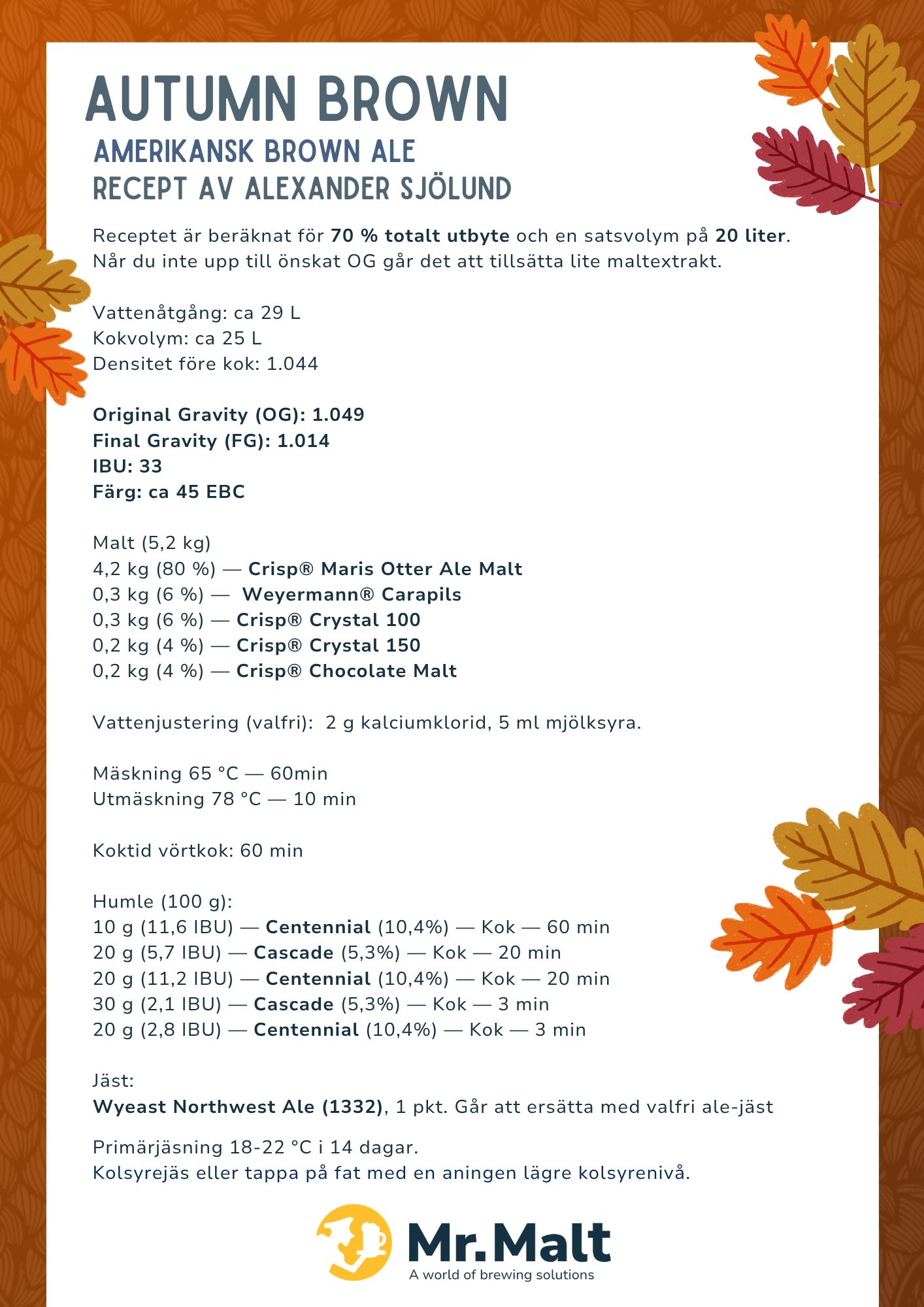
Lambik
Vill du komma igång och göra egen suröl? Det är inte så svårt som man kan tro, oftast handlar det om att ha tålamod och låta bakterierna jobba. Här är ett recept på en klassisk lambik.
Italo Pils Shining Smooth
Our hop expert Peter Högström put this recipe together for a super-fresh take on a Italo Pils with the new hop variety Saaz Shine.
IPA-Day 2024
Celebrate the International IPA Day with this hoppy West Coast IPA!

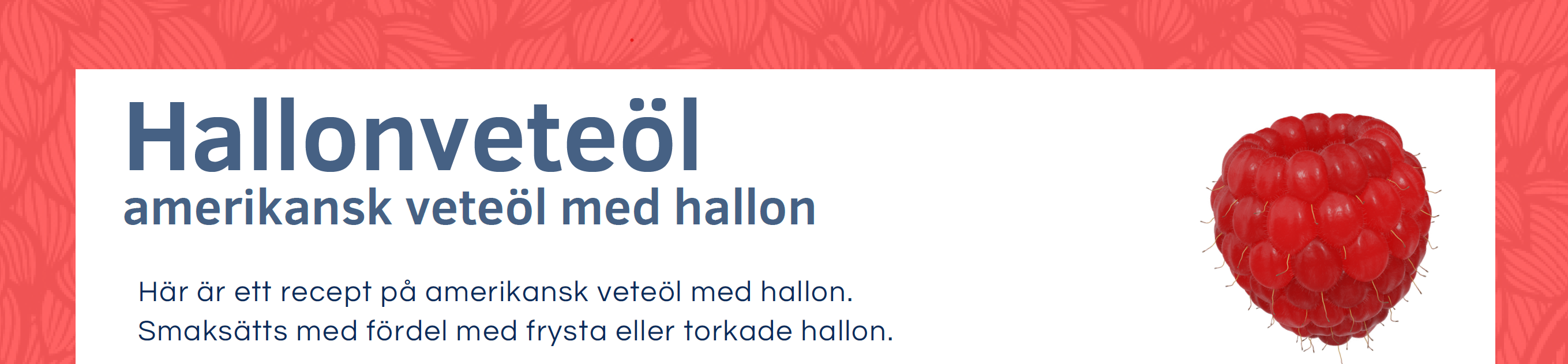
American Raspberry Wheat ale
A smooth and refreshing wheat beer which focus on the raspberries rather than the character of the yeast strain.
English Strong Bitter
A delicious combination of the best English malts, yeast and hops. The recipe is from the winning brew of Humlegårdens' employees homebrewing championship, brewed by Alexander Sjölund. Cheers!

Easter Saison
A malty belgian saison that pairs well with all the special Easter treats.

Pale ale with Brett - inspired by Orval
This beer is not that complicated to brew and the recipe is reminiscent of a Belgian IPA or bitter. But the fermentation process is a bit different.
You need two different types of yeast for this beer: a Belgian ale yeast strain and a Brettanomyces yeast strain.
Fermentation begins with the ale yeast strain and the Brett is pitched in the later stages of fermentation, before bottling.
For bottle conditioning, a normal dose of priming sugar is added and you should use slightly more pressure-resistant beer bottles.
This beer continues to develop in the bottles, as Brettanomyces ferments out the priming sugars and continues to contribute other flavors during the maturation. Preferably let the beer have 2 - 3 months of maturation after bottling.

English Pale Ale
A pale and quite satisfying traditional pub ale, thirst-quenching and very sessionable.

Belgian Blonde ale
A pale, mildly fruity and very likeable belgian ale with warming qualities.

Spiced Christmas ale
This is a dark amber Christmas ale, spiced with cinnamon, nutmeg and star anise.

Dark Mild which may be modified into a Pumpkin ale
Dark Mild ale could be considered the original session ale. The dark versions are often generously flavourful session ales. This recipe includes Toasted Malted Oats, a lightly roasted oat malt from Crisp which adds notes of cookies and fudge.
If you wish to modify this recipe into a Pumpkin ale for Halloween, view the recipe PDF for additional ingredients and brewing steps.

Steinbier
Bronze medalist from Humlegårdens' Summer Beer Meetup. The brewers Daniel Borg and Max Westman boiled the wort with scorching hot stones that was heated on the fire with charcoal and birch wood. The effect of this is some caramellization from Maillard reactionsm with some subtle lingering smokiness.The process transformes this Helles into something with a tad more colour and flavour than what could be expected from the relatively simple recipe formulation.
If brewing this beer, please be careful when handling the hot stones. Choose stones with high heat capacity and which doesn't crack easily, for example gray wacke, granite or sandstone. And choose an appropriate kettle that can withstand the heat and weight of the stones.
If you can't get the Smaragd hop variety, we recommend hop varieties Hallertauer Tradition, Magnum or Perle as substitutes.
Mead flavoured with blackberries
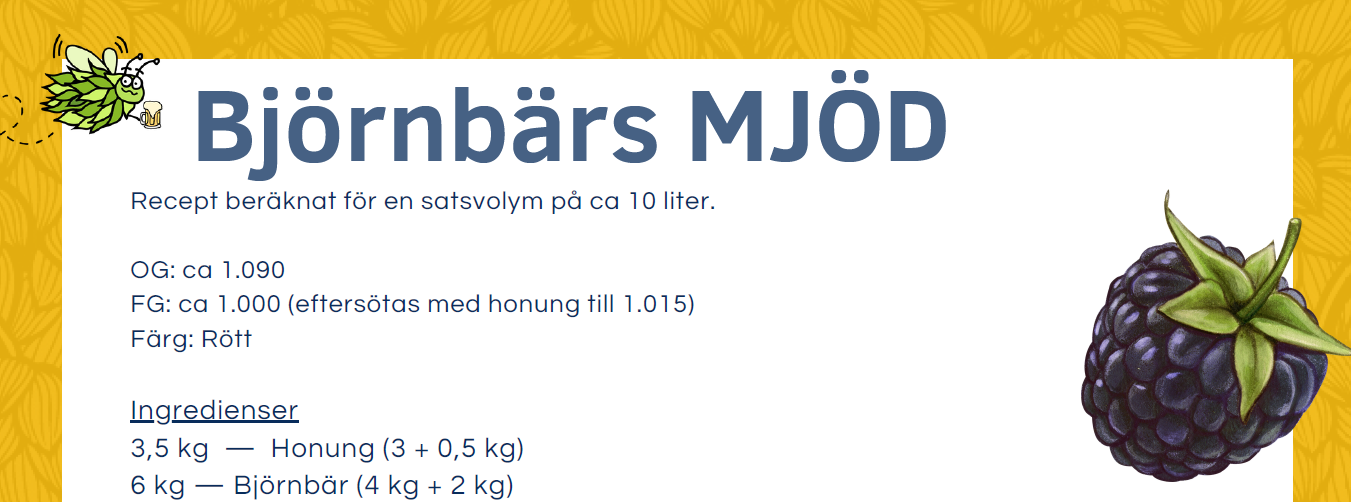
In some ways it is much easier to start a mead fermentation, compared to the process of brewing beer. But you will notice that a mead fermentation requires a bit more attention during the primary and secondary stages of fermentation. Such as multiple additions of yeast nutrients, additions for stabilization and additions for flavouring and balancing the mead.Read more in our mead guide or in a book.
PalePexx NEIPA
This was the winning brew from our Summer Beer Meetup 2021, brewed by Humlegårdens' own Ari Vallius.
Hefeweizen
Alt 1: Flavour the beer with berries, fruit or flowers
Alt 2: Hopfenweizen.
Add your favourite aroma hop and add it as a 30 min Hop Stand. Examples of hop varieties: Mosaic, Idaho 7, Equanot, Motueka, Saaz, Hallertau, Spalter Select...
A slightly increased OG and some dry hops are also nice options in a Hopfenweizen.
Alternativ 3: Dunkelweizen.
Replace some of the pale base malts with Munich malt type II and 100 g Carafa® 2 Special (Weyermann®).
Alternativ 4: Dark wheat malt.
Replace some of the pale wheat malt with dark wheat malt, for some colour and a slightly sweet maltiness.
Alternativ 5: Try a decoction step mash procedure!
Adds tasty melanoidins and colour to your wort. The traditional way of brewing a German Wheat Beer.
Alternativ 6: ... or simplify the mash procedure.
If you can't be bothered with doing a step mash, try doing a single step mash of 65 °C for 80 minutes.
Still, you can add a mash out through a single decoction mash step. After 45 - 50 minutes, remove about 1/3 of the thinnest part of the mash. Bring to a boil and boil for some 20 minutes. Add the decoction back to main mash, which should increase in temperature to over 70 °C.

Eldorado APA

Kveik APA
A hoppy but balanced American pale ale fermented fast and warm with the Voss Kveik yeast strain.

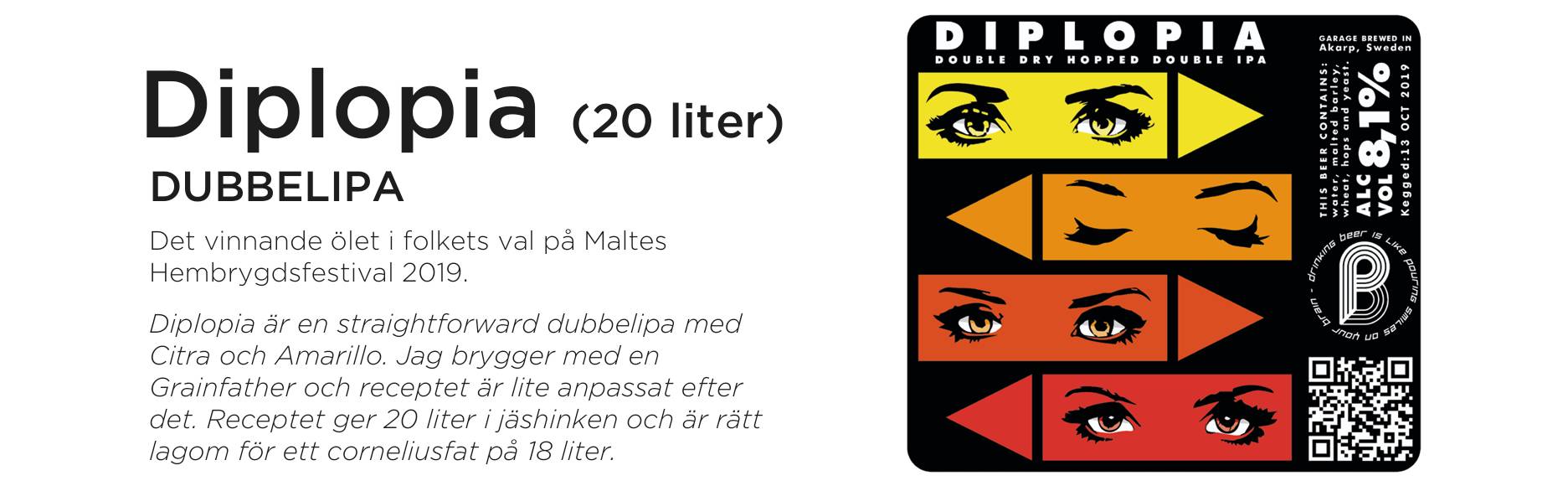
Diplopia - Double IPA